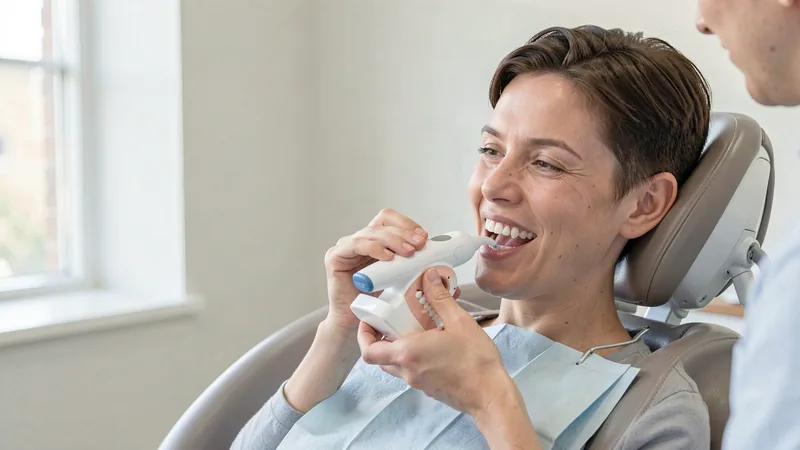
A denture that lifts when you eat, traps food underneath or rubs a sore spot is usually described as a denture problem. Mechanically it is a fit problem: a removable denture is held by the way its base sits on the ridge, and the ridge underneath it keeps changing as the bone shrinks after teeth are lost. Published United States ranges put an implant-supported overdenture at $6,000 - $15,000 per arch and a full-arch All-on-4 at $15,000 - $30,000 per arch, with a graft at $600 - $3,000 per site where the bone is too thin. The plan and the fee come from the dentist who examines you.
What a moving denture is telling you
A conventional denture is held by the fit of its base against the ridge of bone and gum that used to carry the teeth. On the upper jaw the palate helps with suction; on the lower jaw there is much less to work with. Nothing anchors a conventional denture into bone.
When the base stops matching, the denture lifts, tips under the load of chewing, and rubs wherever it moves. That is why sore spots tend to appear in the same places again after an adjustment, and why food collects under a base that no longer sits down properly. Adhesive can help hold it, and it is a reasonable workaround, but it does not change the underlying fit or rebuild the ridge the denture rests on.
None of that is a judgement about the denture or the person wearing it. It is what a removable prosthesis does as the mouth underneath it changes.
Why the fit keeps changing over the years
After a tooth is lost the ridge beneath it shrinks, and a denture does not shrink with it. A base made to fit the ridge as it was becomes a base that fits it less well as time passes, which is why a denture that was comfortable when it was new can become loose years later without anything going wrong.
The more teeth that have been missing for a long time, the flatter the ridge usually is, and the less there is for a base to sit on. It is the same process that makes a graft more likely before an implant: where the bone has shrunk too far, a plan that relies on a fixture in the bone may need the site rebuilt first, and the published range for that step is $600 - $3,000 per site.
The routes that keep a removable denture
An implant-supported overdenture keeps a removable prosthesis but changes what holds it. Two to four implants are placed in the jaw and the denture clips onto them, so it still comes out for cleaning but no longer relies on suction and fit alone. The published range is $6,000 - $15,000 per arch.
Whether that is possible, and how many implants the case needs, is read from a CT scan and planning stage, which published ranges put at $100 - $500. Where the bone is too thin for the planned implants, a graft or a sinus lift is done first and has its own healing time before the implant stage.
Maintenance does not stop when the treatment finishes. Implants need cleaning and review, and peri-implantitis - inflammation around the implant - is the failure mode those follow-up appointments are looking for.
Fixed instead of removable
The other route abandons the removable prosthesis. A full fixed arch, commonly All-on-4, uses four implants to carry a bridge that stays in place: you do not take it out, and your hygiene routine is done around it rather than with it out of your mouth. The published range is $15,000 - $30,000 per arch, with higher-end zirconia arches quoted above that.
Some full-arch cases load a temporary bridge on the day of surgery, with the final prosthesis following once healing is complete. Osseointegration, the process of the implant fusing with the bone, commonly takes three to six months, so the temporary stage is what covers that period.
If only one or two teeth are missing behind a partial denture, the smaller option is a single implant with its finished crown, published at $3,000 - $5,000 and up to $6,000 in some guides where a graft is needed.
What to ask, and how the matching works
Ask whether the denture you already own can be used over the implants or whether a new prosthesis is needed, and what that does to the fee. Ask how many implants the case needs and why, whether a graft is expected and whether it is inside or outside the quoted figure, and what the annual review involves. If sedation is part of the plan, ask which sedation permit the dentist holds - Illinois dentists are licensed by the Illinois Department of Financial and Professional Regulation, and sedation carries its own permit level.
Then the matching itself: tell us what moves, when it moves, whether you have been told a graft is needed, and which part of Chicago or Cook County you are in. We introduce you to licensed local implant dentists whose offices cover your area, at no charge for the introduction. The examination, plan, itemised fee and warranty come from the dentist.
Frequently asked questions
Can my existing denture be converted to sit on implants?
Sometimes, and sometimes not. An implant-supported overdenture can be a new prosthesis made to clip onto the implants, or in some cases an existing denture is adapted, and which applies depends on the condition and the space available. Ask that question before comparing numbers, because a quote for implants alone is not comparable to a quote that includes a new prosthesis.
Will adhesive solve it?
Adhesive can hold a loose denture in place for part of the day, and many people use it for exactly that. What it does not do is rebuild the ridge the denture sits on or stop the base from continuing to change shape against it. It is a workaround rather than a change in how the denture is held, which is why a fit that keeps failing usually becomes a question about the design rather than about the adhesive.
What does an implant-supported denture cost in Chicago?
Published United States ranges put an implant-supported overdenture, meaning two to four implants holding a removable denture, at $6,000 - $15,000 per arch. A full fixed arch is published at $15,000 - $30,000 per arch. Where the CT shows the bone is too thin, a graft or sinus lift is commonly $600 - $3,000 per site, and a CT scan and planning stage $100 - $500. Chicago quotes vary with the implant system, who makes the final teeth and how many staged visits are involved, so ask for the itemised version.
Will I be without teeth while implants heal?
That is a question for the practice, and the answer depends on the plan. The options include continuing to wear your current denture through the healing period, or, in some full-arch cases, carrying a temporary bridge from the day of surgery until the final prosthesis is fitted once healing is complete. Ask directly what you would be wearing during each stage before you agree to a plan.
Related


Sources
Dental Implants tools & calculators

All 10 free Dental Implants tools
Cost calculators, comparisons and checklists. No sign-up.
Cost calculator
Estimate the range for a case in about a minute.

Cost guide
Every published appliance range, in one page.
Consultation checklist
What to bring and what to ask before you commit.

Knowledge quiz
Ten questions on costs, timing and coverage.

Which option fits my situation
Eight questions that point to an appliance path.
Cost & Payment tools
Cost estimator, financing and payment planning, insurance and what you may still owe

Cost & coverage tools
Cost driver planner, insurance and code checker, multi-stage cost planner

Compare & choose tools
Treatment finder and practice comparison scorecard

Prepare & safety tools
Appointment question builder, readiness checklist, medical-history and medication notes

Checklists & Answers tools
Practice questions, records and imaging checklist, second opinion, smile check